"Chimera". Poetry collection.
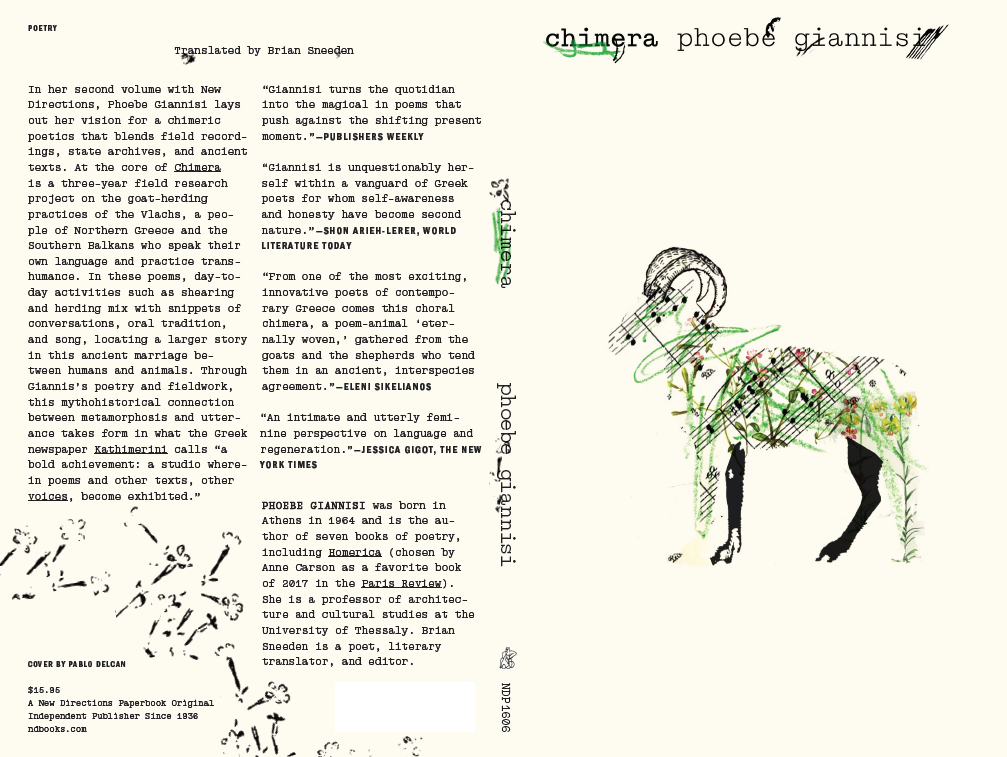
Translation into English by Brian Sneeden.
Published by New Directions, 2024.
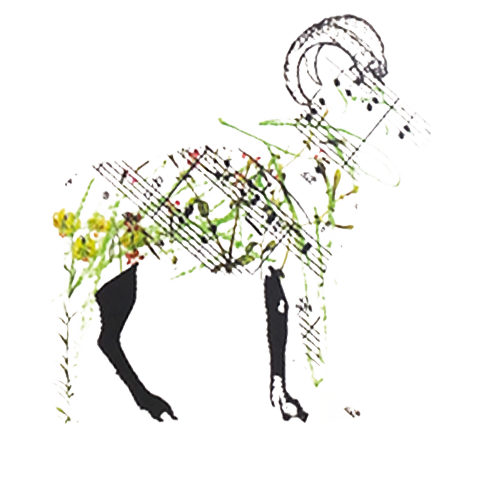
Cover engraving by Pablo Decan.
In her second collaboration with New Directions, Phoebe Giannisi presents her vision of a chimeric poetics that brings together archival field recordings, state archives, and ancient texts. At the heart of Chimera lies a three-year field study of the livestock-raising practices of the Vlachs, a people of Northern Greece and the southern Balkans who speak their own language and practice transhumant pastoralism. In these poems, everyday activities such as shearing sheep and grazing are interwoven with fragments of conversations, oral tradition, and songs, embedding them within a broader narrative around this ancient coexistence of humans and animals. Through her poetry and fieldwork, Giannisi shapes a mythohistorical connection between transformation and the utterance of speech,a bold synthesis which, as the Greek newspaper Kathimerini wrote, constitutes "a daring achievement: a study in which poems and other texts, other voices, are displayed and converse with one another."
"Giannisi turns the everyday into magic; her poems resist the decay of the present moment."
— Publishers Weekly
"Giannisi undoubtedly belongs to the vanguard of great poets, for whom self-knowledge and sincerity have become second nature."
— Sjón, World Literature Today
"From one of the most compelling and innovative poetic voices in contemporary Greece comes this choral Chimera, a poem-animal, eternally woven, gathered from the goats and the shepherds who lead them through an ancient, interspecies symphony."
— Eleni Sikelianos
"An intimate and deeply female perspective on language and regeneration."
— Jessica Au, The New York Times
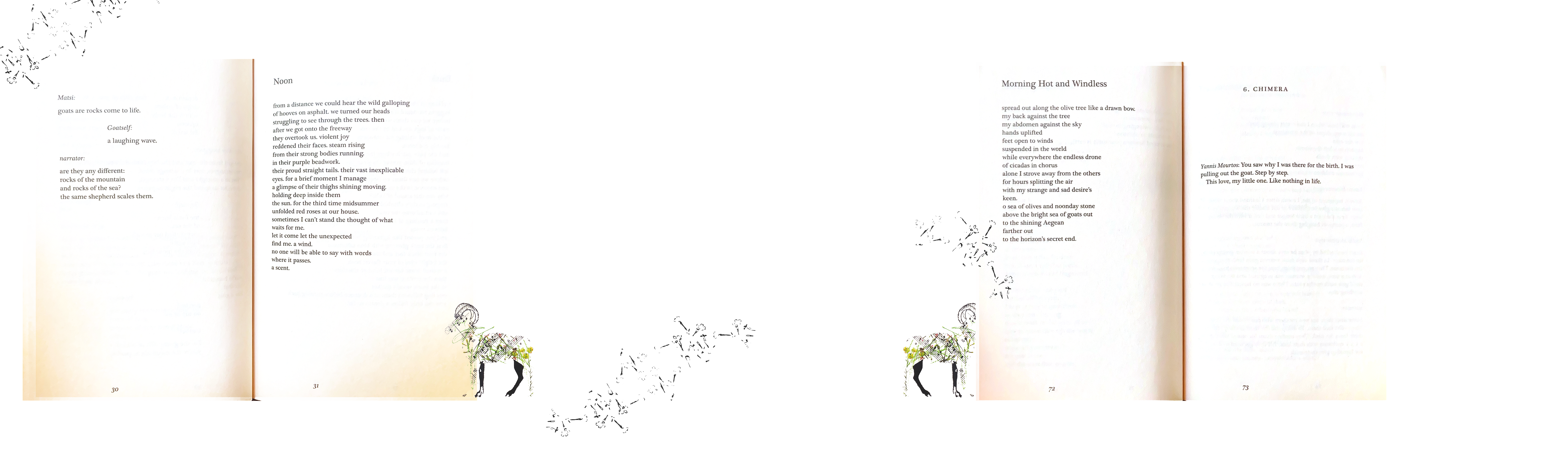
https://lareviewofbooks.org/article/a-world-bent-toward-degradation :
...“A human life: if someone kept a diary from the day they’re born till the last day, it would say, I lived. How could you argue with that? You couldn’t say oh they lived like this, or had this specific life. No. It’s bigger than that.” These are the words of Uncle Yannis, one of the 53 voices in the book, a 70-year-old goat herder from the town of Aetomilitsa. Perhaps it is his aphorism that—from among the book’s several gorgeous moments—I’ll keep with me the most: we live unspecific lives. Lives that, with their movements, their violences, their harvests, fall in line, not requiring, in the end, any real characterization. “It’s bigger than that,”Yannis reminds us. He speaks, I think, about a life whose furthest purpose is to be lived, a life that absconds qualitative record. A life not made of words.
If the book expresses a morality of any kind, it is certainly the fraught sense of dominion we possess over the animals in our lives:
the division of everything as it corresponds to human needs.
the division of time as it corresponds.
the division of space time work utility
as it corresponds to their needs.
factory or labor camp.
It is a worthy moral examination, performed by Giannisi to great effect and with great care. In the center of Giannisi’s poetic frame, one encounters a serious and glimmering inquiry into the human-animal relationship. And yet I’m moved most of all by the stray moments of this book, the happenings at the frame’s margin, the book’s momentary lapses into confession, philosophy, and phantasmagoria. By all of Giannisi’s lyric shrapnel. “What do you carry on you when you leave?” one nameless speaker poses to another, in a scene without much context or orientation. “My dark. My own piece of dark,” the second voice returns. At the close of another poem: “[Y]ou can only follow a dream so far.” It is by the grace of these departures, I think, that the book achieves its true figure, its true state of chimera. This book, at its best: a many-mouthed poetic speaker with a wild imaginative sense. And, behind her, always looming: the world, which is an agent, never simply backdrop or canvas. A world bent toward degradation, a world that will always—no matter how large or various the herd of speakers—have the last say: “[T]imeweather tears apart what humans animals weave.”
Poetry Foundation, Library Book Pick: Chimera: https://www.poetryfoundation.
https://www.ndbooks.com/book/chimera/
https://www.lyrikline.org/en/authors/phoebe-giannisi
https://literarytranslators.org
https://pen.org/announcing-the-2025-pen-america-literary-awards-finalists/
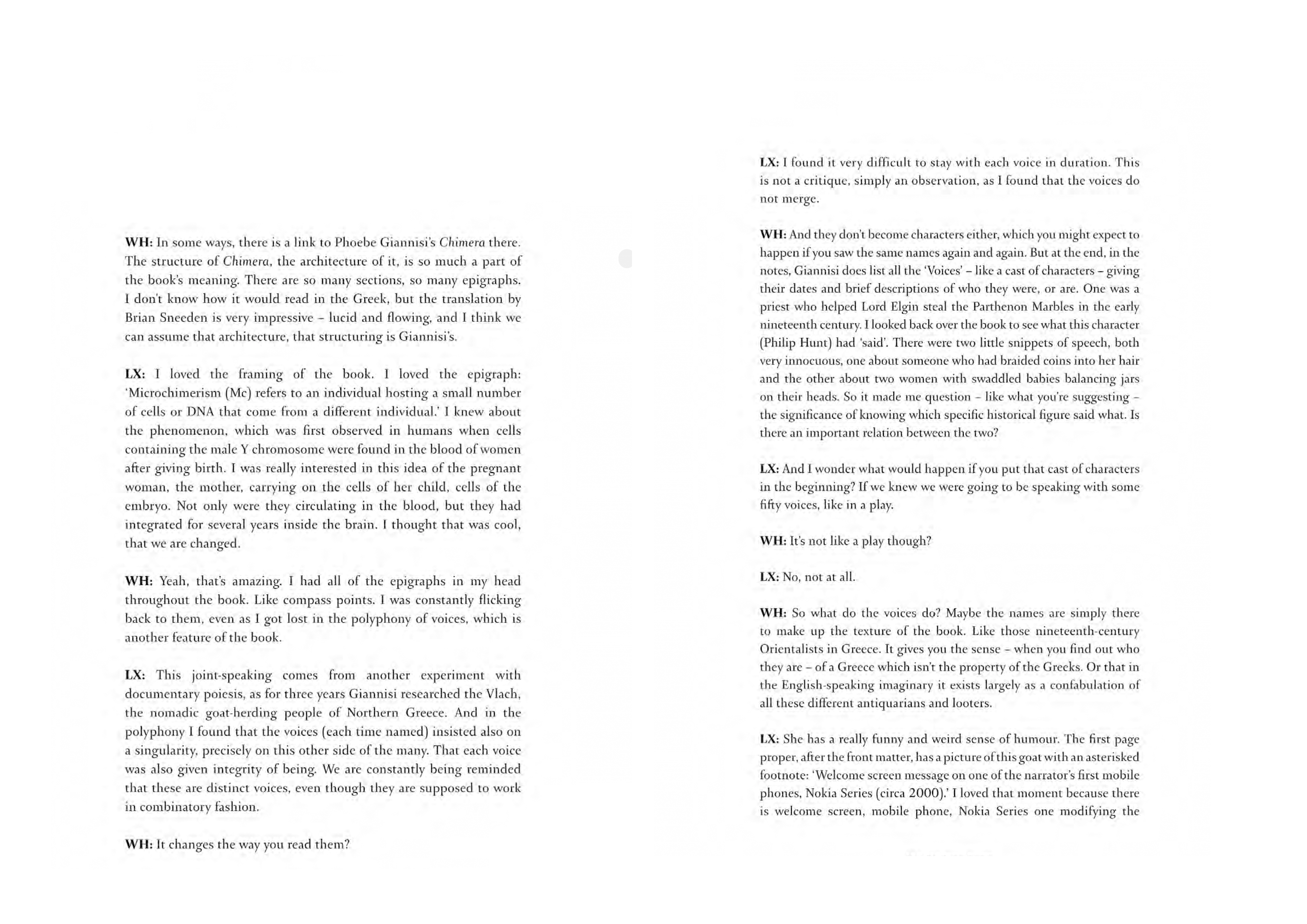
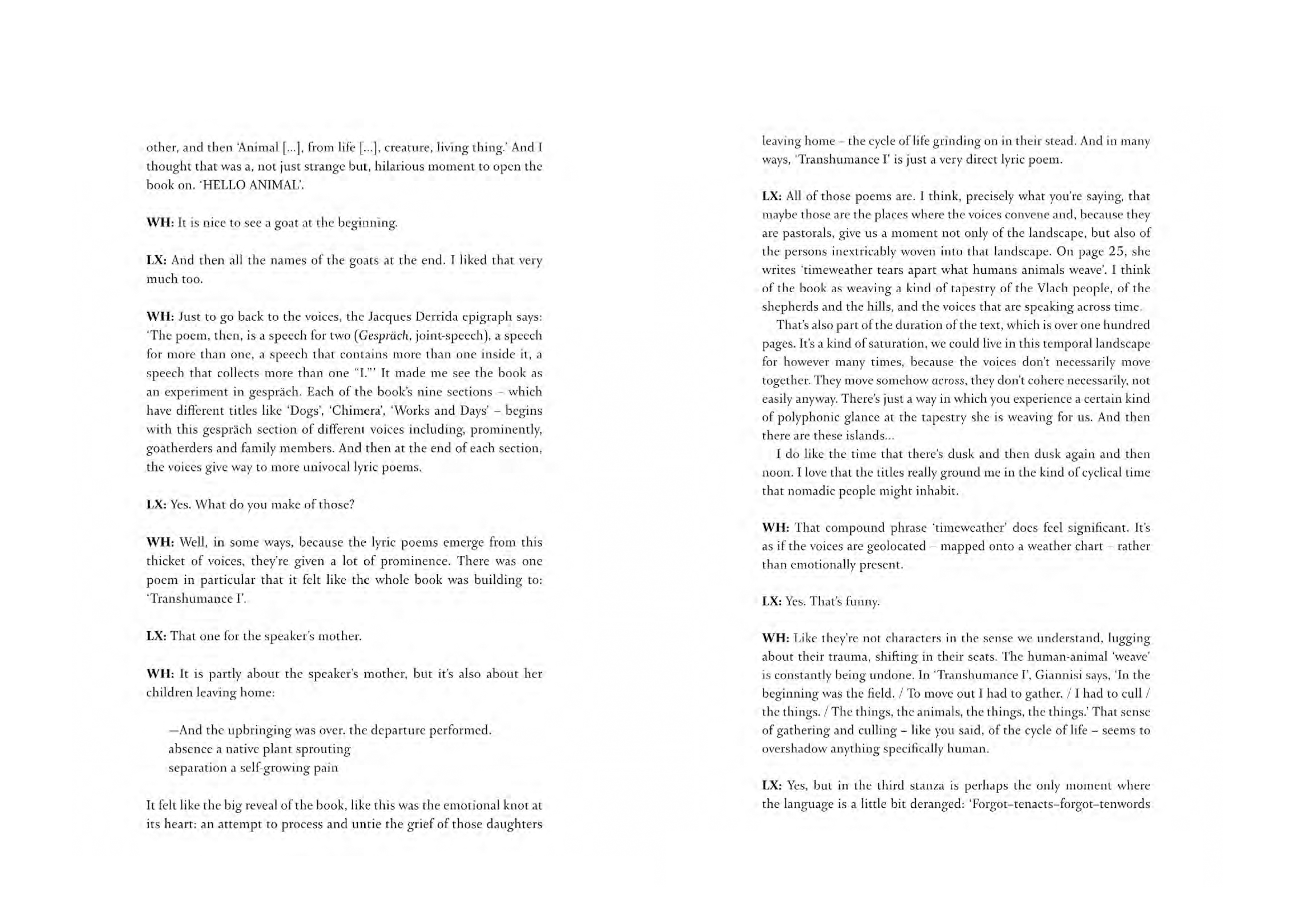
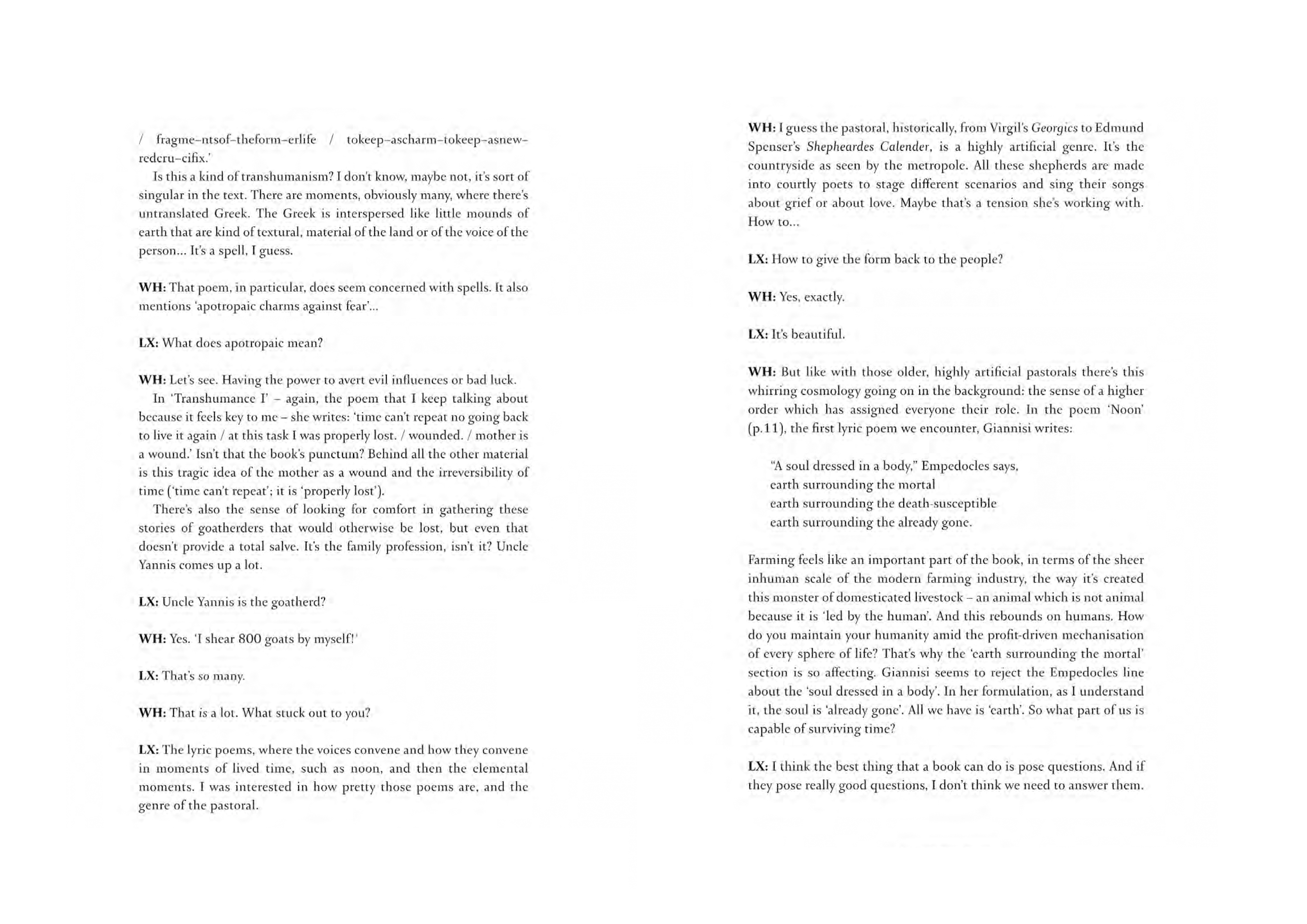
Poetry Review - Review of Chimera (Will Harris and Lynn Xu):