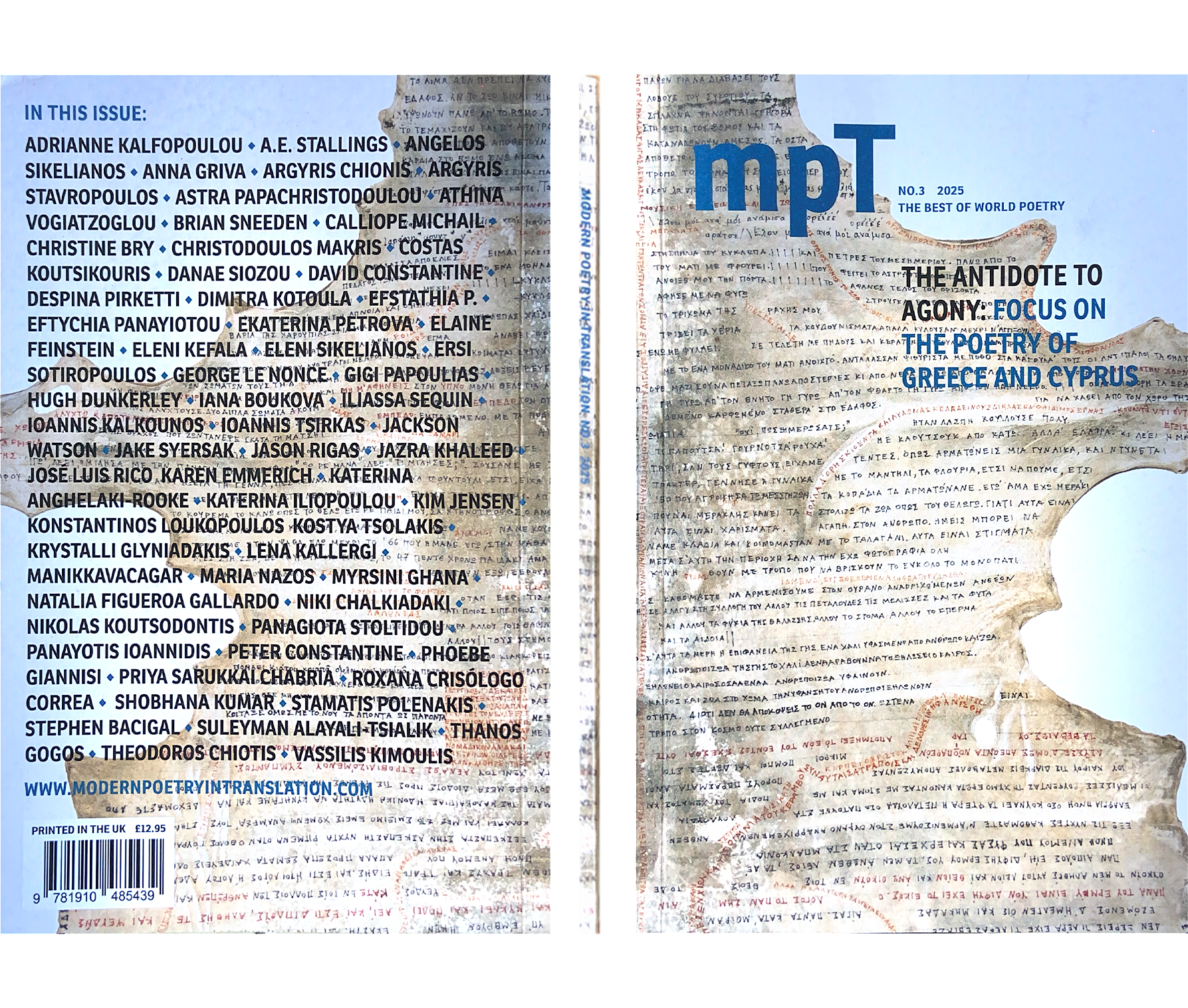
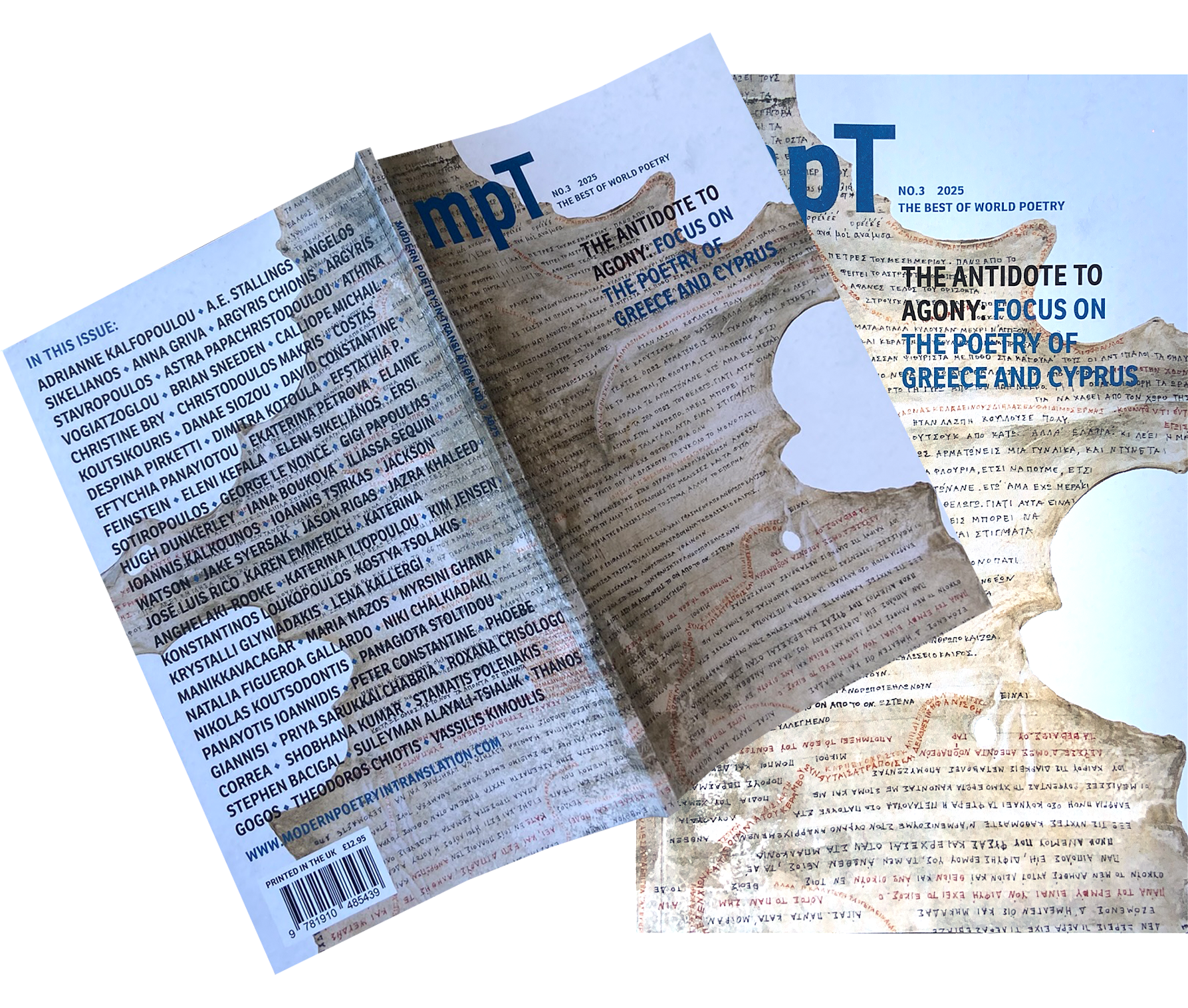
MPT The Antidote to Agony: Focus on the Poetry of Greece and Cyprus, guest edited by Jessica Sequeira, features 30 selections of poems translated into English by contemporary poets expanding the linguistic boundaries of Modern Greek, Bulgarian and Arvanitika, reflecting on migrant crossings in the Mediterranean, female friendship, the transcription of orality, imagined plagues, the encounters of bodies, the AIDS pandemic, and artistic ruin, among other themes. Greek poetry, as perhaps all poetry, opens the heart to the beyond, to the liminal condition. The truth is that the idea of a national focus will forever be complicated given that migrants also form part of the tradition of a region, both those entering and those leaving (which is why a poem into Greek is also included, by a Cypriot poet residing in Ireland).
The authors translated in the Focus are Angelos Sikelianos, Anna Griva, Argyris Chionis, Argyris Stavropoulos, Christodoulos Makris, Danae Siozou, Dimitra Kotoula, Efstathia P., Eftychia Panayiotou, Eleni Kefala, Ersi Sotiropoulos, George Le Nonce, Iana Boukova, Iliassa Sequin, Ioannis Tsirkas, Jazra Khaleed, Katerina Anghelaki-Rooke, Katerina Iliopoulou, Konstantinos Loukopoulos, Krystalli Glyniadakis, Myrsini Ghana, Niki Chalkiadaki, Nikolas Koutsodontis, Panayotis Ioannidis, Peter Constantine, Phoebe Giannisi, Stamatis Polenakis, Suleyman Alayali-Tsialik, Thanos Gogos, Vassilis Kimoulis. Two introductory essays by Brian Sneeden and Kostya Tsolakis provide context.
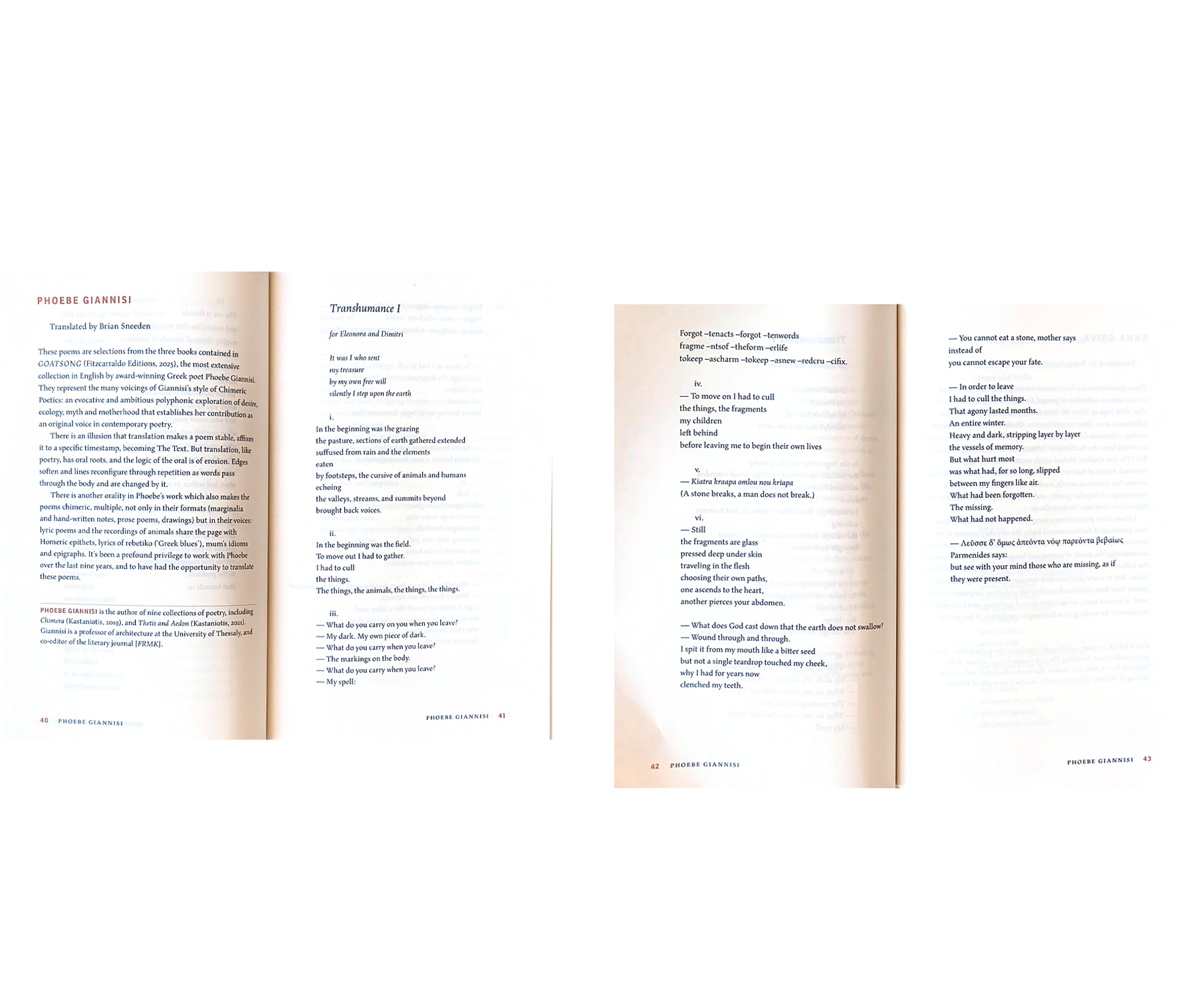
In addition there are three non-Focus poem selections by Christine Bry from French, Manikkavacagar from Classical Tamil, and Roxana Crisólogo Correa from Peruvian Spanish.
Cover artist statement:
Aegis
Dimensions: 1.50 m x 1.15 m
Materials: Processed goat leather / parchment
Design, texts, drawings: Phoebe Giannisi
Initial drawings: Mando Xanthouli, Eirini Paraskevopoulou
Leather processing: Argyris Kappas
Aegis is a parchment, the processed hide of a young female goat. It is my costume, produced during a span of days in 2015. It’s my mask, my shield, half-human, half-animal, half-me, the earth and the soil, the land. It is also a book: on it, in red and mainly black ink, I improvised the text from a collection of excerpts and recorded transcripts which became the first form of my poetry collection, Chimera, which followed a three-year field research project on the goat-herding practices of an indigenous community of Vlachs.
On the side where the hairs once were, the one in contact with my own skin, the back side, I’ve drawn a Map of Greece to show the lines in the territory made by the goats of the flock of Yannis Mourtos. From Kalamaki in Thessaly to Aetomilitsa in the shadow of the Pindus mountains. The Vlach shepherds I documented are a distinct population that lives in the Balkan area, has its own language and still (though only a few) practice nomadic pastoralism, transhumance, grazing their flocks South in winter and high up in the mountains in summer, hundreds of miles away. As a nomadic people, they followed their own calendar and route, and because locals never knew when they would appear, and because authorities failed to regulate or normalise them, they shared the goat’s fate and were as undesirable as their animals; even today, the nature of their work often marks them as Other.
Yannis Mourtos shares a proverb:
Ό,τι κάνει η γίδα στο πουρνάρι, το βλέπεις στης γίδας το τομάρι
what the goat does to the holly, the holly does to the goat
or
what the goat inflicts on the holly shrub will be told on the goat’s skin
meaning
what you do to others will happen to you
—from Chimera (New Directions 2024) and Goatsong (Fitzcarraldo 2025)
The word aegis comes from aiga (“female goat”) and carries a polyphony of meanings: Zeus’s shield, protection, a fierce storm, a goatskin. In my writing I divided the skin into “members”, with the double-meaning of bodily member and the singing piece: the excerpts of the polyphonic text, that is, mine and others, that I collected from spoken words or from texts, on the lines and points of the Aegis that corresponded to meaningful units. For example, on the legs I wrote pieces that concerned nomadism and the movement of animals, on the neck I wrote parts that concerned death and sacrifice and on the belly was divided in two by a red line that appeared both in front and behind and was that of the path of the Vlach nomads that I had briefly followed in their common life with the animals. From the red line down, which corresponded to my waist, the writing was written upside down so that when I lift the lower part of the apron up, the audience sees the map that I describe below, while I can read its content normally. All my writings: these pathways, tracks left on the ground.
– Phoebe Giannisi
